



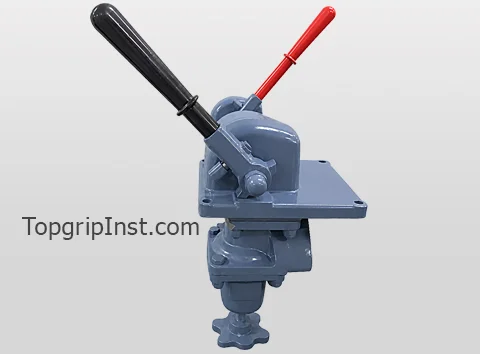
The SA-9 is a self-lapping, pressure-maintaining independent brake valve — i.e. it controls only the locomotive’s brakes, not the whole train.
Main Purposes
| Purpose | Explanation |
| For Locomotive-only Braking | It applies and releases only locomotive brake cylinders, not the train brakes. |
| For Shunting & Yard Movement | Helpful while attaching/detaching wagons or during loco movements inside shed/yard. |
| Fine Brake Control | Allows gradual and precise braking of loco independently, improving handling. |
| Prevent Train Brake Activation | Loco can stop or control speed without applying brakes on full train through A9. |
| Useful in Loco-Lite / Banking Operations | When locos run alone or bank a train, SA9 controls only the locomotive brakes. |
| For Smooth Coupling | Soft braking avoids jerks while coupling coaches/wagons. |
Key functions of the SA9 valve
- Independent brake application: Allows for graduated application and release of the locomotive’s brakes.
- Locomotive brake release: Enables the release of the locomotive brakes while the train brakes remain applied.
- Self-lapping: Automatically maintains the desired brake pressure in the locomotive cylinders against normal leakage.
- Graduated control: The pressure is varied in proportion to the movement of the brake valve handle, providing precise control.
FAQ’s
What is the difference between A9 Brake Valve and SA9 Brake Valve?
The A9 brake is used for slowing the entire train, whereas the SA9 is used only for braking the locomotive.
Since the A9 operates across the entire train, it is used during normal running. However, the SA9 brake, being employed only on the locomotive, is used for specific purposes such as shunting and coupling. In these situations, the locomotive driver requires precise control of the locomotive, which is provided by the SA9 brake system. Furthermore, during shunting and coupling, it is necessary to brake the locomotive independently of the coaches—hence the need for the SA9.
Besides being used in different ways, the A9 and SA9 brake systems also operate differently. While the A9 brake valve slows the train by reducing Brake Pipe (BP) pressure, the SA9 brake valve stops the locomotive by directly applying air to the locomotive brake cylinders.
Why is it called the “SA9”?
The A9 and SA9 names trace their origins to Westinghouse Rail Systems, the famous British company that revolutionized train braking systems. Westinghouse invented these brakes and named them accordingly.
A9 – Automatic brake valve
SA9 – Self-lapping independent brake valve
The “9” likely referred to the model number in that series.
Since engineers and the industry prefer familiarity and standardization when it comes to nomenclature, the names “A9” and “SA9” have remained in use since they were introduced in the mid-20th century.
The SA9 is a self-lapping brake valve. What does that mean?
To understand what a self-lapping brake valve does, one first has to understand how the earlier non-self-lapping brake systems worked. In these systems, when the driver chose to apply the brakes, he would rotate a brake handle (or, in some cases, move a brake lever), which would allow air to flow into the brake cylinders. This would increase the brake cylinder pressure and thereby increase the braking force.
However, once the correct amount of brake pressure had been built up and the locomotive had started slowing at the desired rate, the driver would need to stop rotating the brake handle in order to prevent further air from flowing into the brake cylinders. Otherwise, the braking force would continue to increase, causing the locomotive to slow down more rapidly than desired.
This method imposed a high workload on the driver and became particularly challenging on gradients, wet tracks, or when the locomotive was hauling heavy loads. As a result, precision braking was difficult to achieve consistently.
In a self-lapping brake system, the position of the brake handle represents the desired brake cylinder pressure — and therefore the desired braking effort — rather than the duration for which air is admitted into the brake cylinders.
Hence, when the driver moves the handle to a certain position, the SA9 automatically introduces sufficient air into the brake cylinders to create the pressure corresponding to that handle position. Once the required pressure is achieved, the SA9 automatically cuts off any further flow of air into the brake cylinders without requiring any further input from the driver.
In other words, the system automatically “laps” or balances itself at the selected brake pressure.
Hence the term “self-lapping brake valve”.