



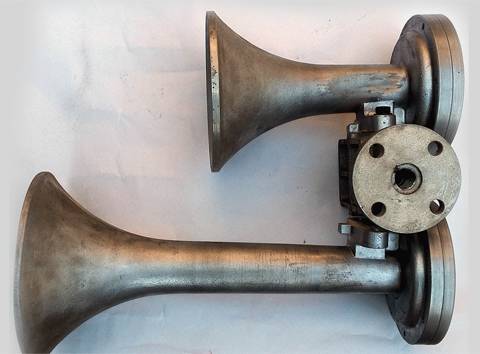
An Air Horn is a pneumatic sound-producing device that uses compressed air to create a loud, high-frequency audible signal.
Main Purpose of Air Horn
To produce a loud, audible warning sound using compressed air to alert people, vehicles, or other trains of an approaching train.
Why It Is Needed
| Reason | Explanation |
| Safety at Level Crossings | Warns pedestrians and vehicles of an approaching train. |
| Warning in Stations & Yards | Alerts staff during shunting or train movement. |
| Communication on Tracks | Signals driver intentions (start, halt, emergency) to nearby crews. |
| Visibility in Poor Conditions | Fog, night, or heavy weather — audible signal compensates for low visibility. |
| Long-Distance Alert | Air horn can be heard several hundred meters away, much farther than electric horns. |
Key Functions of Air Horn
| Function | Description |
| 1. Provides audible warning | Produces a loud sound to alert pedestrians, vehicles, and railway staff. |
| 2. Enhances safety at level crossings | Warns of approaching train to prevent accidents. |
| 3. Signals in stations and yards | Communicates train movements such as start, stop, or shunting operations. |
| 4. Long-distance alerting | Loud horn can be heard several hundred meters away, even in noisy environments. |
| 5. Works in poor visibility conditions | Useful during fog, rain, or night operations where visual cues are limited. |
| 6. Emergency signalling | Can be used to warn of immediate danger or hazard on tracks. |
| 7. Durable and reliable | Operates using compressed air; effective under various weather conditions. |